Look a little closer
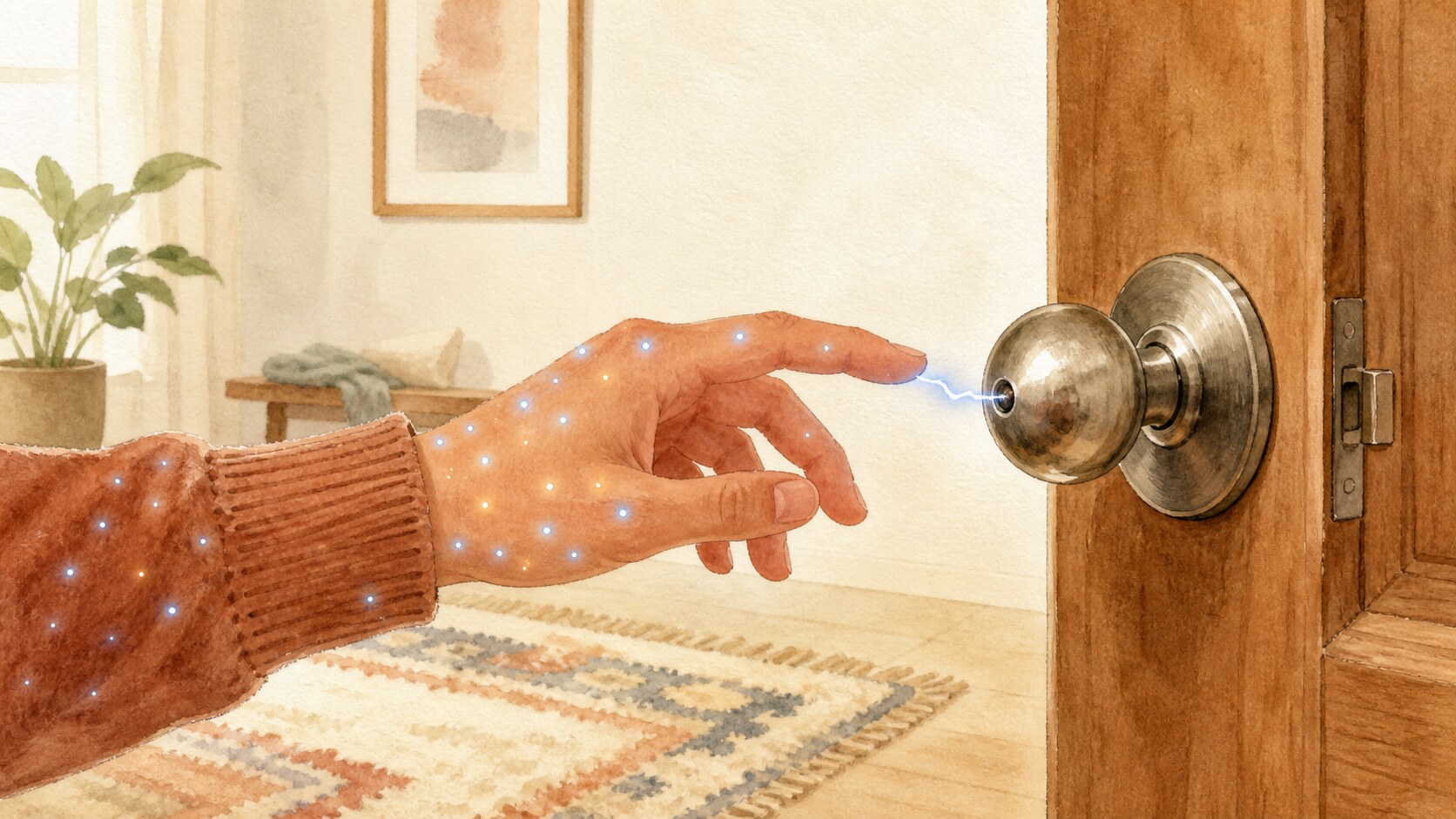
A doorknob zap occurs when charge built up between your body and the knob moves in a very short time. The rapid redistribution can make a tiny spark and click, while sensory nerves in the skin register the momentary current as a sharp sting.
An imbalance can develop when different materials touch and separate. Walking on carpet or rubbing clothes repeats those contacts, allowing electrons to transfer from one surface to another. Although this is often called frictional electricity, friction does not create charge from nothing. The direction and amount of transfer depend on the material pair and surface conditions.
Poor conductors such as rubber soles and many synthetic fabrics restrict the routes by which charge can leak gradually from your body. A large electrical potential difference may then develop between you and nearby objects. A metal handle conducts well, offering a new path as your hand approaches or touches it.
If the potential difference is high enough, air can ionize before the finger reaches the metal, briefly creating a channel for current. A static discharge may involve thousands of volts, yet an ordinary event stores little charge and lasts only a tiny fraction of a second. A routine doorknob shock is therefore usually an annoyance, not the same phenomenon as sustained current from household power.
Low humidity is one reason static becomes conspicuous in heated rooms during winter. Moisture can form thin films on some surfaces, helping accumulated charge leak away. Dry conditions reduce that leakage route. Humidity is not the only variable, however: footwear, flooring, clothing, movement and access to ground all influence how much charge accumulates.
Keeping indoor humidity within a range appropriate for the building and occupants, and reducing repeated contact between static-prone materials, can lower the frequency of large discharges. Touching metal first with a key may move the spark from the fingertip to the key's tip and reduce the sting, but it does not prevent charge transfer.
Separate from a small household sting, electrostatic discharge can harm sensitive electronics or become an ignition source around flammable vapor or dust. Those settings require approved procedures such as grounding, bonding, antistatic work surfaces and properly used wrist straps rather than improvised tricks. A discharge too small for a person to notice can still affect an electronic device.
EDITORIAL RESPONSIBILITY
FactosBrain Editorial Desk
The FactosBrain Editorial Desk researched and reviewed this article under our editorial policy. We assess error reports under our corrections policy.