Look a little closer
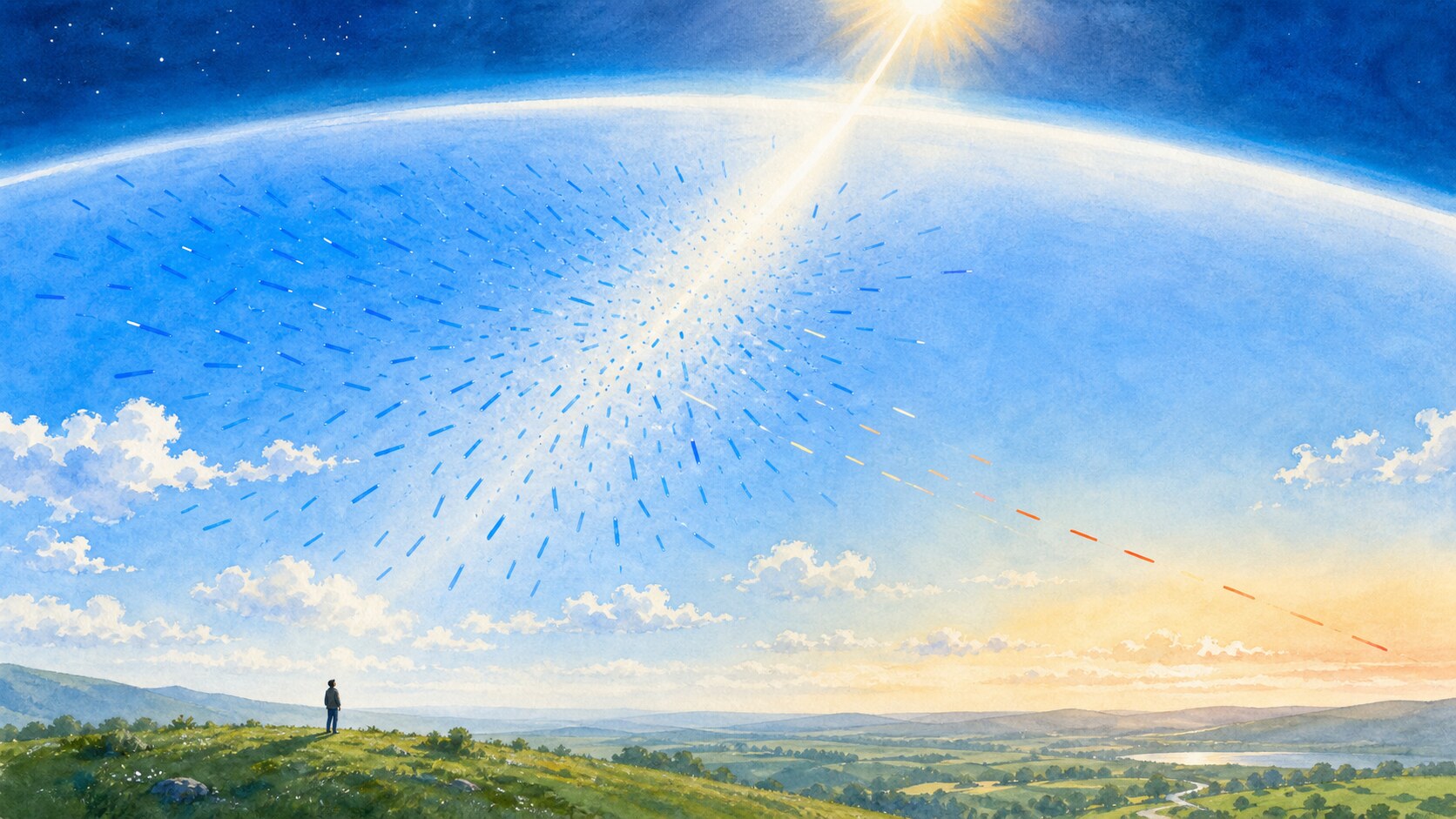
A clear daytime sky looks blue because molecules in the atmosphere scatter shorter wavelengths of sunlight more strongly. Direct sunlight contains a broad mix of visible colors and appears nearly white. During its passage through air, however, much of its blue-range light is redirected across the sky and into our eyes.
This process, produced by nitrogen and oxygen molecules much smaller than visible wavelengths, is called Rayleigh scattering. Its strength rises steeply as wavelength becomes shorter. Blue and violet light therefore scatter far more readily than red light, allowing us to see light from parts of the atmosphere well away from the Sun.
That raises an obvious question: why is the sky not violet, since violet has an even shorter wavelength? Several effects combine. The Sun supplies less violet than blue within the visible range, human vision is less sensitive to violet, and some violet is absorbed. The mixture reaching our visual system is consequently perceived mainly as blue.
The blue is not simply the ocean reflected like a mirror. The same atmospheric scattering occurs over continents, and a blue sky remains visible far from any sea. At very high altitude there are fewer molecules overhead to scatter sunlight, so the sky becomes a deeper, darker blue and eventually approaches the black background of space.
Near the horizon, the sky often appears pale blue or whitish. Light from that direction travels through a longer atmospheric path and may be scattered several times. Larger particles such as haze droplets and dust also scatter visible colors more evenly than individual molecules do. More moisture and aerosols can therefore wash out the saturated blue.
Red sunsets are another outcome of the same wavelength preference. When the Sun is low, its light crosses a much longer section of atmosphere. Much of the blue and violet has been scattered out of the direct beam before it reaches an observer, leaving a larger share of orange and red wavelengths around the solar disk.
Cloud droplets and ice crystals are large enough to scatter many visible wavelengths together, which is why clouds usually look white or gray rather than blue. Other planets can have different sky and sunset colors because their gases and suspended particles differ. Sky color is not a fixed cosmic backdrop; it is an interaction among light, particles, viewing path and human vision.
EDITORIAL RESPONSIBILITY
FactosBrain Editorial Desk
The FactosBrain Editorial Desk researched and reviewed this article under our editorial policy. We assess error reports under our corrections policy.