Look a little closer
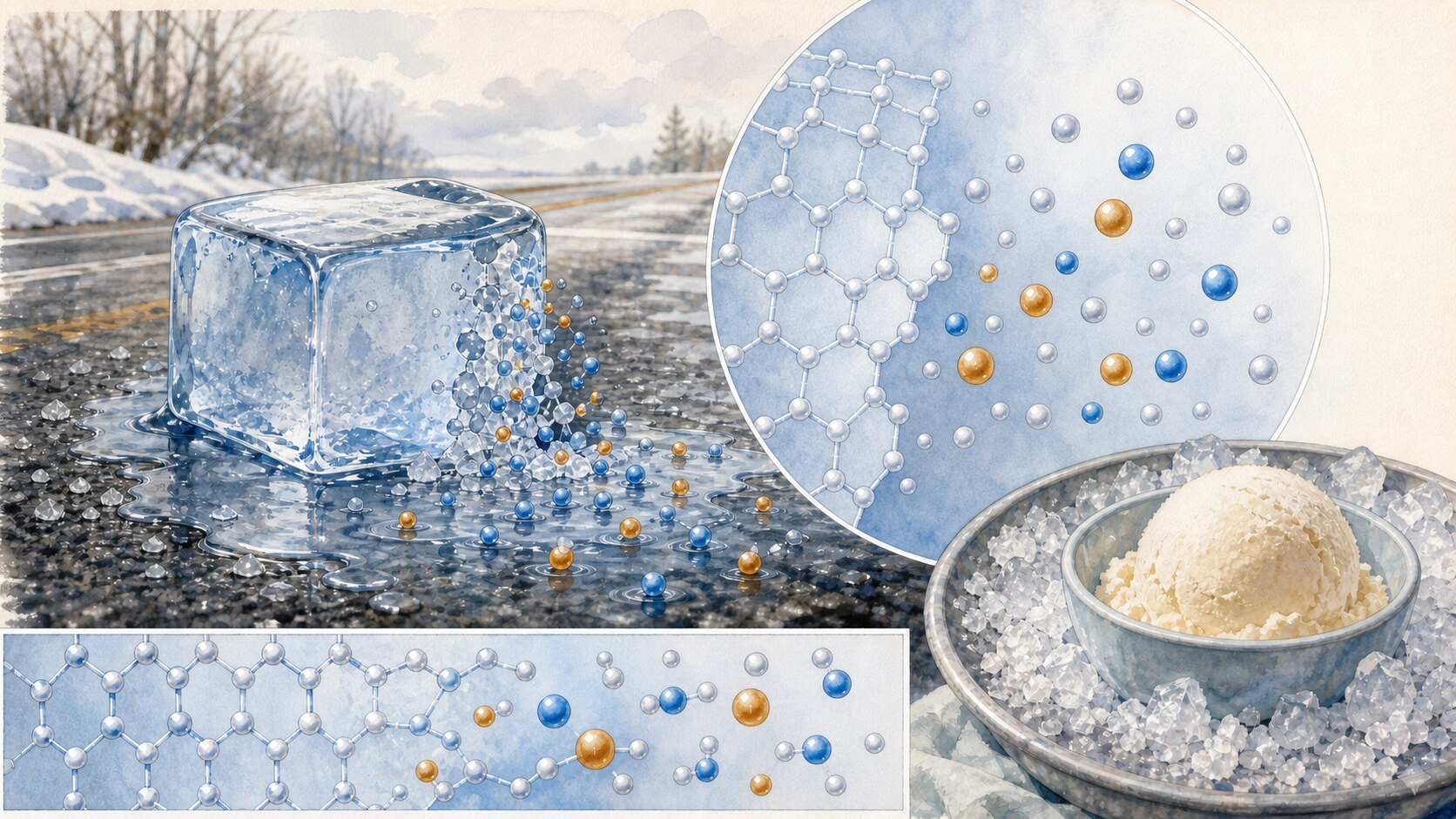
Salt does not melt ice simply by making it hot. It dissolves in water at the ice surface and lowers that water’s freezing point. Pure water and ice are in equilibrium near 0 degrees Celsius at ordinary pressure, but liquid water containing dissolved ions can remain stable at a lower temperature. If the surroundings are warmer than the solution’s new freezing point, additional ice melts into brine.
Even a solid-looking ice surface is dynamic: water molecules continually leave and rejoin the crystal. A very thin liquid-like layer can exist at the surface, giving a salt crystal somewhere to begin dissolving into sodium and chloride ions. The resulting brine touches more ice, allowing the liquid region to grow.
For an ice crystal to grow, water molecules must join an organized lattice. Salt ions are generally excluded from that lattice and remain in the liquid, changing the thermodynamic balance between liquid water and solid ice. More energy must be removed before the solution can freeze. This shift is called freezing-point depression.
The size of the shift depends strongly on the concentration and number of dissolved particles, not merely on the visible mass of salt. Sodium chloride separates into two kinds of ion in water. Salts such as calcium chloride can produce more ions per formula unit under comparable conditions and can depress the freezing point further; calcium chloride also releases heat as it dissolves.
No deicer works at arbitrarily low temperatures. A sodium-chloride-and-water mixture at the right composition can remain liquid down to a eutectic temperature of about −21.1 degrees Celsius. On roads, dilution and slow dissolution make ordinary salt lose useful effectiveness at much warmer temperatures. Very cold ice and a shortage of available liquid water also make it harder for the process to begin.
Road salt is valuable not only for melting existing ice but for preventing snow and ice from bonding tightly to pavement. Applying brine before a storm can lower the freezing point of the first water that forms. Ploughs can then remove the loosened snow and slush; salt does not replace the mechanical work of clearing a road.
There is an environmental and engineering cost. Chloride salts corrode vehicles and bridges and can accumulate in soil, plants and fresh water, so application rate and timing matter. The precise meaning of “salt melts ice” is that dissolved salt moves the water–ice equilibrium to a lower temperature. Only when temperature, concentration and available water are suitable does that equilibrium shift become visible melting.
EDITORIAL RESPONSIBILITY
FactosBrain Editorial Desk
The FactosBrain Editorial Desk researched and reviewed this article under our editorial policy. We assess error reports under our corrections policy.